| Home |
|
|
|
|
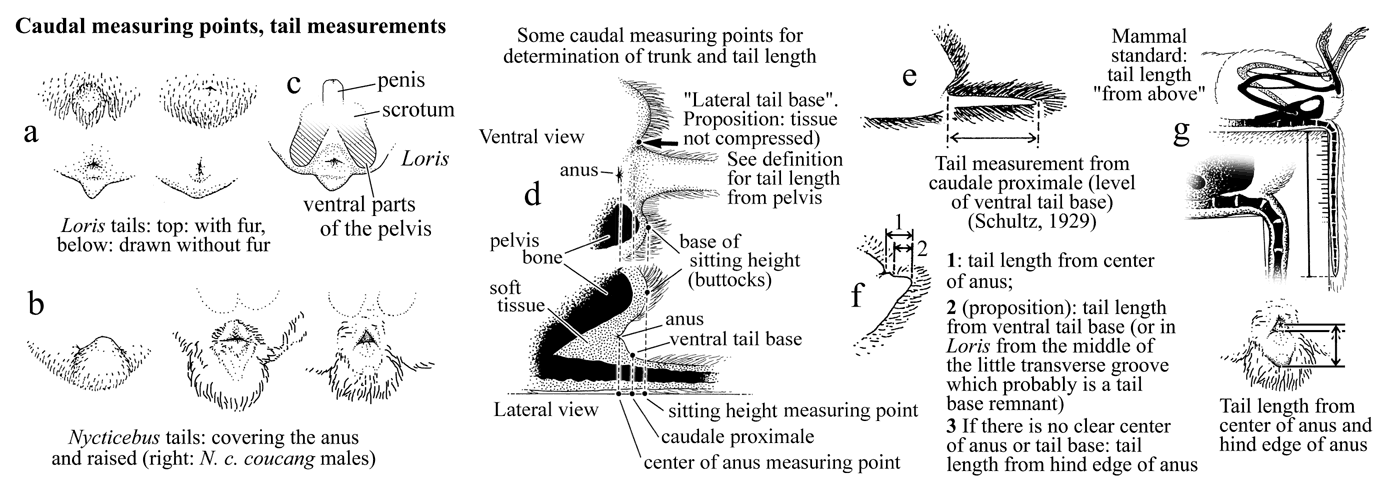
Figure 8 a:
caudal trunk- / tail measuring points, tail measuring
standards and propositions
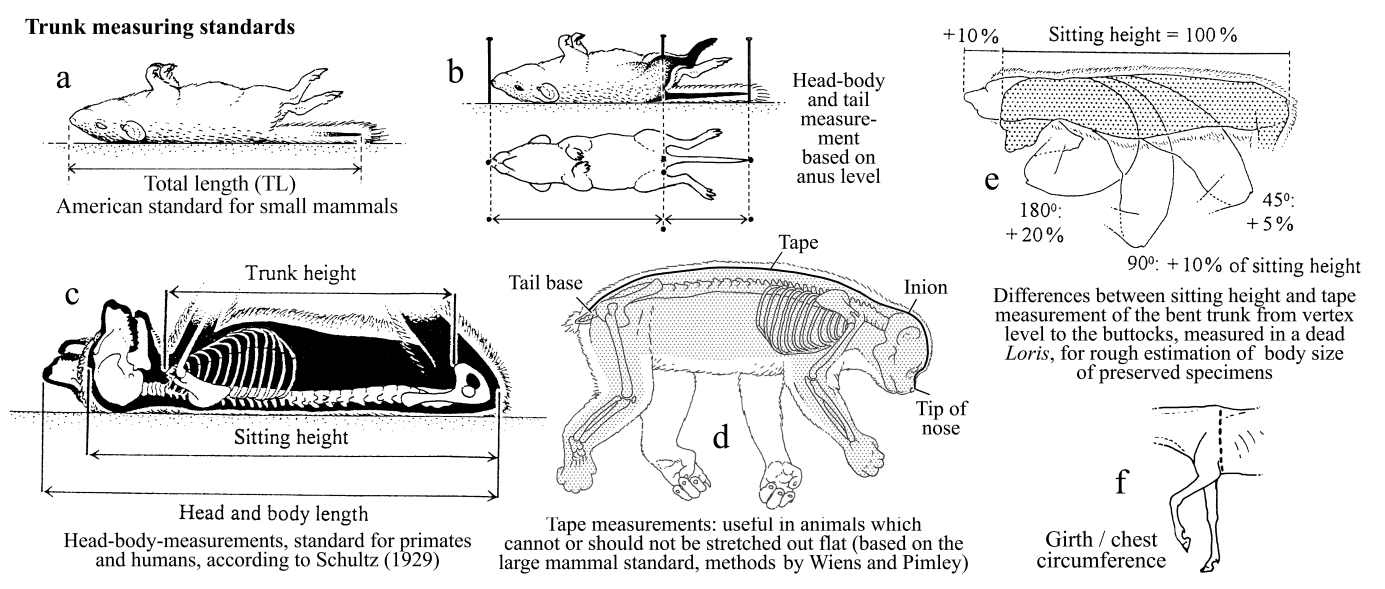
Figure 8 b:
trunk measuring standards and propositions ( for some
measuring points
see figure 8 a, above, and definitions below)
Trunk measurements, alphabeticallyFigure 8 a: caudal trunk- / tail measuring points, tail measuring standards and propositions
Tail length
Definition of some points and body parts for tail-measuring
Definition of some measuring methods with different determination of the tail base measuring point
Relative measurements
In lorises measuring of the very short tail may be difficult, making certain standard methods impossible; therefore here several possibilities are shown
Figure 8 b: trunk measuring standards and propositions ( for some measuring points see figure 8 a, above, and definitions below)
Definitions for standardized measuring and description of trunk and tail and measurements found in loris and potto literature
Weight: in g
Trunk measurements, alphabetically:
Biacromial diameter (Schultz 1929): see under shoulder breadth.
Bisacromial breadth (Osman Hill 1942): see under shoulder breadth.
Bitrochanteric diameter (Schultz 1929): see under hip breadth.
Bitrochanteric breadth (Osman Hill 1942): see under hip breadth.
Chest girth / girth (chest circumference): measured with a tape closely around the chest "immediately behind the forelegs" (Lundrigan 1996) / "behind the shoulders" (Ansell 1965) / "at the level of insertion of the fourth pair of ribs into the sternum" (Schultz 1929), in live or freshly dead animals because soon after death the body may become distended. Since shoulder blades are not fixed to the trunk, a standardized posture of the forelegs seems necessary. Usually measured in domestic animals or ungulates. A correlation between girth measurement and weight has been found in certain species.
Head and body length, small mammal standard (Europe),
primate
standard (Schultz 1929: (most frequently used to measure
overall size
of small mammals): from the tip of the nose to the base of the
tail, animal
fully extended. Specimens should be measured lying flat on their
back on
a level surface (Schultz 1929).
Head-body-length, small mammal standard (USA):
usually
computed by subtracting tail length from total length. Since
several ways
of tail length measurements with different results exist (see
below), additional
direct head-body-legth measurement might be more advantageous.
Hip breadth = bitrochanteric diameter (Schultz 1929), bitrochanteric breadth (Osman Hill 1942): straight distance between right and left trochanter major (see figure), 'with the lower limbs touching each other' at the knees. (marked age changes and profound generic differences in the formation of the ilium cause any pelvic width between the ilia to be less advantageous).
Length of the dried, straigtened vertebral column (on skeletal material, according to instead of trunk measurements, for certain purposes, combined lengths of thoracic, lumbar and sacral regions (Schultz 1929, Erikson 1963). Advantages: 1) greater accuracy in measurement; 2) can be measured on skeletal material and therefore allows measuring of a greater number of specimens; 3) it is more easily related to partial museum skeletons and to fragmentary remains of vertebral columns in the fossil record. Comparison with trunk length as measured by Schultz would make a conversion factor necessary which must be determined separately for each genus.
Shoulder breadth = biacromial diameter (Schultz 1929), bisacromial breadth (Osman Hill 1942): Straight distance between right and left acromion. (Greatest. width between the deltoid muscles, which is sometimes chosen for a "shoulder breadth," is of little morphological significance and varies with the development of the musculature and the direction of the upper arms).
Sitting height (= stem length), primate
standard:
measurement for primates, from vertex to the most caudal point of
buttocks,
over the ischial tuberosities, measured parallel to the body axis.
Specimens
should be measured lying flat on their back on a level surface.
(Schultz
1929)
In slender lorises measured, head and body length was about 10%
longer
than sitting height.
Some lorisids, for instance pottos, may have so tense muscles that it is impossible to stretch them out fully with rather straight vertebral column as required in the the small mammal and primate measuring standards (one of us: L. Pimley). In such cases and in live animals not supposed to be stretched violently, the following tape measurements along the middle of back and head have been proposed or used in earlier studies, with the animal stretched out as far as the natural body shape allows (more or less natural posture):
Tape measurement from tip of nose to caudale proximale (tail base). This is also a standard measurement in large mammals (see for instance Rabinowitz et al., 2000) and used for prosimians by other researchers (one of us: L. Pimley)
Annotation: most figures illustrating this type of measurement do not show properly whether the measuring tape is supposed to be pulled straight over dents or lying on the animal´s body surface everywhere. A larger figure in Nagorsen and Peterson (1980), however, indicates that the latter is correct, making the measurement a bit longer than with the other method.Tape measurement from Inion to caudale proximale = body length, head not included. (Inion = middle of the ridge on the hind edge of skull where the nuchal muscles insert). Measured for certain studies, but not for taxonomic comparison (one of us: Liz Pimley)
Tape measurement from tip of nose to buttocks: up to a point as far caudal as the middle between the distal edges of buttocks (Wiens 1995)
Total length (TL), small mammal standard (USA):
animal
lying flat, but not stretched on the back, the nose directed
forwards,
the tail lying straight and flat on the surface. Measurement from
the tip
of the nose to the tip of the tail (terminal tail hairs not
included)
Trunk height (anterior trunk height, formerly:
thoraco-abdominal
height): from suprasternale to symphysion, measured parallel to
the body
axis. Specimens should be measured lying flat on their back on a
level
surface. (Schultz 1929)
Tail length
There are different ways to measure tail length in small mammals.
In
any case, the tail must be straightened, if possible, but not
stretched.
In all measuring methods described below, the distal measuring
point is
the tip of tail, also called Caudale distale by Schultz 1929: (the
most
distal point on the tip of tail, terminal hairs or a caudal
filament in
young fetuses are not included). For the proximal measuring point,
several
definitions exist; the determined "tail base" in all cases is not
identical
with the proximal end of the row of caudal vertebrae, but lying
more distally.
The results of measuring methods differ from each other; measuring
method
must therefore be noted in all cases (Ansell 1965).
In the short-tailed Loridae, measuring of tail length is difficult
(see below). Discussion about use of methods would be appreciated.
As long
as no better solution is found, it seems reasonable to take the
following
three measurements mentioned below: from hind edge of anus, from
ventral
tail base and from lateral tail base.
Definition of some points and body parts for tail-measuring:
Caudale distale: most distal point on the tip of tail (not considering terminal hair tufts or caudal filaments in young fetuses) (Schultz 1929).
Coccygeale: tip of coccyx in tailless primates (Schultz 1929).
Coccyx: most caudal point on the vertebral spine (Schultz
1929).
Definition of some measuring methods with different determination of the tail base measuring point (abbreviations: may be useful for easily noting the measuring method used):
T: tail length from above (traditional method, standard):
Tail
held at an angle of 90º from the body (animal lying on the belly,
tail held up, or tail held flat on the table, body hanging down
over the
edge). Measurement taken on the dorsal side of tail, from its root
(junction
with the body, place where the ventral tail surface bends towards
the anus)
to the tip of tail (caudale distale). In some species such as
otters with
their thick tail base, measuring with this method is impossible.
In Loris, the tail, if externally visible at all, is very
short
with no recognizeable dorsal root and cannot be pulled up for
standardized
mesasuring.
P: Tail length from pelvis: pin slid along the tail
cranially
"until resistance of the pelvis is felt" (Definition of
”pelvis”?*). More
consistent than tail length from above, according to Corbet (in
Southern
1964, quoted by Ansell 1965); according to Ansell 1965 the results
differ
from T, the amount varying with species.
*In Loris, the tissue laterally adjacent to the tail (see
figure)
is rather soft and compressible. Measuring here without pressing
(= L:
Tail length from lateral tail base?) or “pelvis” more
laterally where
bone can be felt under the soft tissue?.
T M/A: tail length from center of anus: may be used in species in which the root of the tail is difficult to locate, for instance in otters: distance from the middle of the anus to the tip of tail (caudale distale) (Ansell 1965, quoting Morrison-Scott 1939, Chapellier 1932 and Dekeyser and Villiers 1948. But in the very short-tailed to tailless slender lorises the distance from the anus to the coccyx) is several mm even in animals with no externally visible tail, not really representing tail length. Maybe more adequate: see below, tail length from ventral tail base.
T H/A: tail length from hind edge of anus (from inner edge of anal opening, determined by the sphincter muscle, to caudale distale) instead of T M/A is proposed by Dr. Kock (Senckenberg Institute) for more exact measuring because the extent of the anal opening may make determination of the center of anus inexact.
V: Tail length from ventral tail base: in Nycticebus,
the tail can be raised or cover the anus. A ventral tail base
(groove,
fold) may be distinguishable or may lie within the anal opening.
In Loris
a transverse groove or dimple may separate the anus from the tip
of coccyx
(Osman Hill 1933); in captive lorises examined it was not present
in all
specimens (data from Ruhr-University). This groove might be a
remnant of
the ventral tail base, and if it is present, measuring from its
center
to the tip of the coccyx may be a more reasonable tail measurement
than
from anus to coccyx (see above, under T M/A).

|
Lorises and pottos: species,
subspecies, local
populations. In: http://www.species.net
|
Last amendment: 20 April 2001
|