| Home |
|
|
|
Captive care, animal welfare, conservation breeding
.
Index
.
![]() |
...... | If you see a loris illegally offered on a market,
please consider the following facts:
For each animal bought, the
next wild loris will be caught, or a loris mother be killed and her infant
taken away from her. Most loris forms are increasingly endangered in the
wild, and since they get few babies which are carefully reared over long
periods, losses due to hunting and trade increasingly threaten wild populations.
Trade with these sensitive
animals who easily die from stress is a cruelty. Please also think about
the fact that wild animals in captivity cannot choose the place and companions
they need for a satisfactory life, and that their senses are much finer
than human ones: they will perceive, and suffer from, things you do not
even notice. Lorises and pottos are adapted to free life in the nocturnal
forest. In captivity, they will suffer and most probably die an early and
unpleasant death from stress, painful diseases caused by wrong feeding
or accidents in an inadequate environment. And they often die a long, agonizing
death, suffering for weeks or even months.
Lorises permanently urinemark
their environment. In addition, they may be dangerous
pets. They can bite fiercely when feeling disturbed, and they produce a
toxin which in humans may cause severe to fatal anaphylactic shock.
And: Since lorises and pottos are threatened and protected animals, buying them and keeping them as pets is illegal in almost all countries, often with very high fines. So: Please
do not buy lorises as pets!
Do not support poaching
and the cruelty of illegal trade!
|
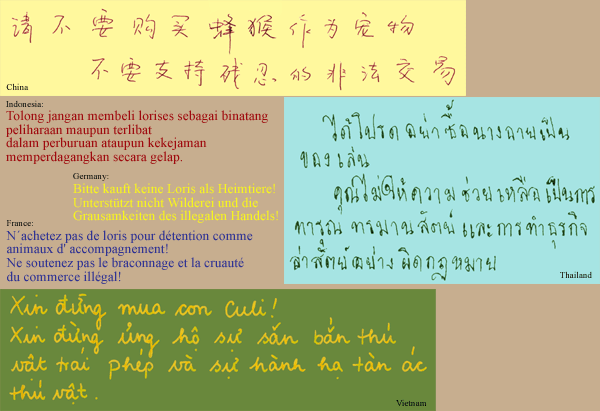
We thank for translation: Xuefeng Zhang (for China), Sandrine + Lionel Cieciura and friends (for Indonesia), Ray Bidasak and friend (Thai), Cheick Coulibaly (French) and some kind Vietnamese students at Ruhr-University who did not note their names and therefore cannot be properly quoted.
| Illegal pet trade
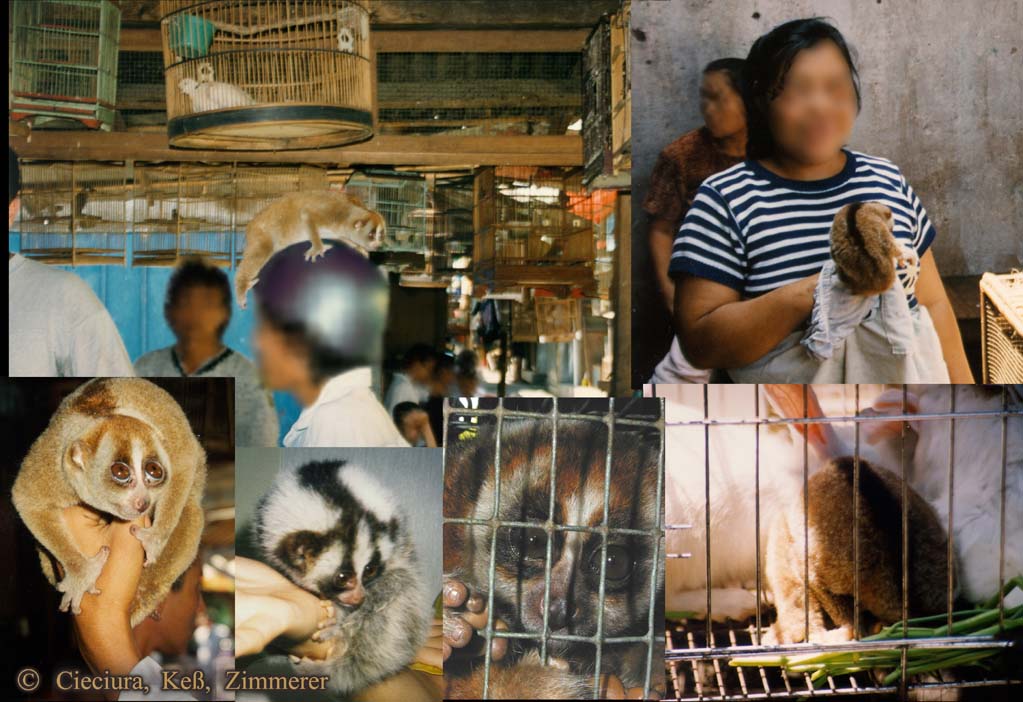
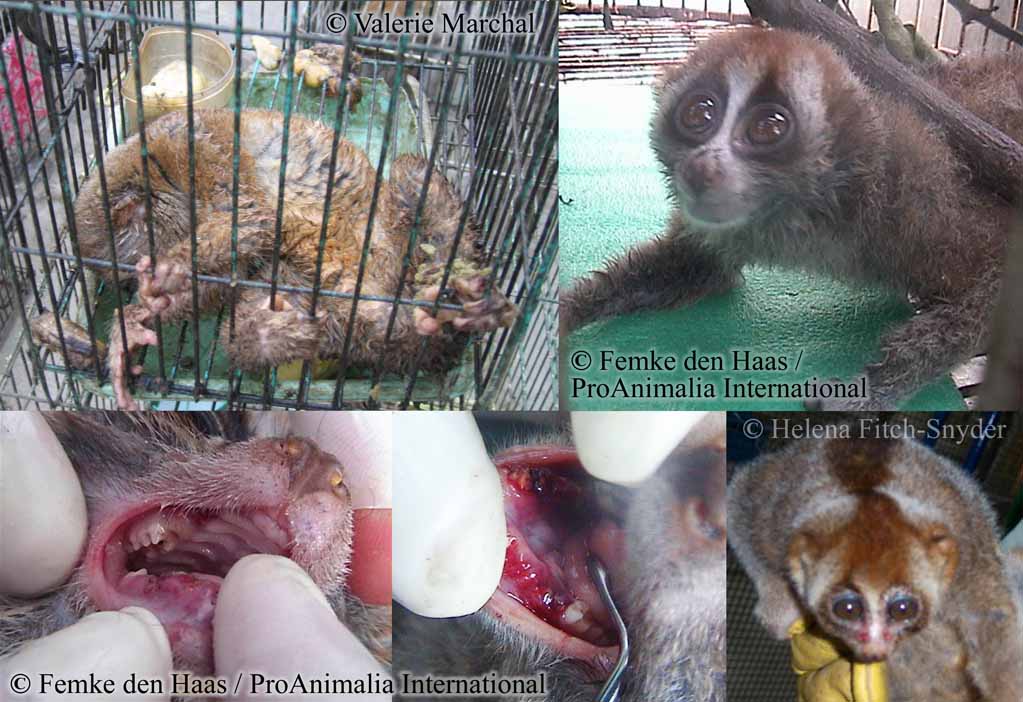
Lorises are regularly offered for sale as pets, for instance on the bird markets on Java. Often traders break or rip their teeth out without anesthesia to sell them as pets unable to defend themselves by biting.
Click on the image for a larger version |
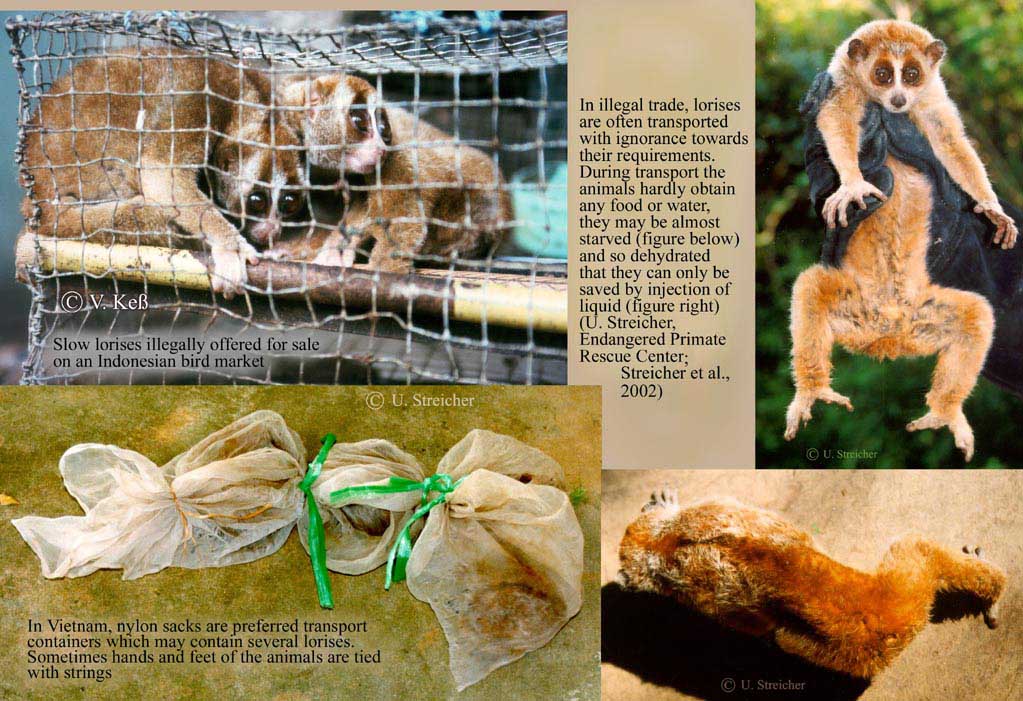
Transport and treatment of the animals in illegal trade is generally
cruel
Click on the image for a larger version |
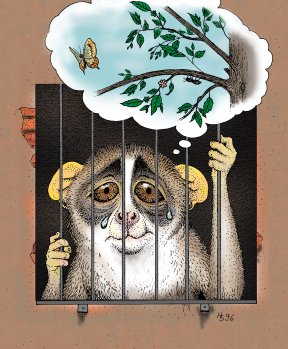
| Suffering and death for human entertainment
Top left: dying loris on a market. Right: after arrival in a rescue station - funds for adequate care for the many animals in trade are desparately needed. See for instance the ProAnimalia International page for information how you can help. ![]() |
If you buy lorises you are directly responsible for their misery and for the deaths of the many animals who do not survive the stress and bad treatment in trade! Even if you buy an animal in order to help - please consider that you promote trade and aggravate the problem by paying the trader. Poaching and selling of lorises must be stopped! See also petition site for measures against trade with wild animals in Indonesia!
We thank all who helped us to show what happens in illegal trade by sending information and photos!
There was a discussion whether husbandry information for threatened wild animals, available via Internet, may promote interest in keeping them as pets, or whether awareness of problems and a possible increase of life span in captivity will rather reduce the amount of illegal pet trade. Any information allowing to verify this would be very interesting (mail-contact). Experience showed that lorises are bought illegally, even if the buyers have no idea how to keep them, so at present the majority believes that longevity of captive lorises increased from few months to possibly about 18 years (their natural life-span) will probably lead to diminished pet trade. If openly offered husbandry information promotes pet trade, this chapter may, in the future, be only available to authorized institutions such as rescue facilities or zoos via password.
Experience with captive care still leaves many
questions open. Particularly inadequate nutrition may cause health problems
or death of animals, this chapter therefore still needs careful consideration
before included here. Please do not blame us for any consequences when
you apply the information offered here and help further improve it when
possible. Regular observation of captive animals (see figures
of signs of problems in the disease database) and non-invasive health
checks, for instance with urine dipsticks, may help to notice problems
in time.
Table of contents
|
|
Some printed sources
Fitch-Snyder, H.; Schulze, H. (eds.); Larson, L. (compiler),
2001: Management of Lorises in captivity. A husbandry manual for Asian
Loridae Nycticebus & Loris spp.). Center for Reproduction
of Endangered Species, Zoological Society of San Diego, Box 551, San Diego,
CA 92112-0551.
Coworkers / coautors: Karen Worley, Lisa Bottcher-Law
(Woodland Park Zoological Gardens), Janet Hawes (San Diego Zoo), Jackie
Ogden (Disney´s Animal Kingdom), Ilse Stalis, D.V.M. (San Diego Zoo),
Meg Sutherland-Smith D.V.M. (San Diego Zoo), Barbara Toddes (Philadellphia
Zoo), Kerri Slifka (Brookfield Zoo), Barbara Lester (Houston Zoological
Gardens), Helga Schulze (Ruhr-University Bochum).
Fitch-Snyder, H.; Schulze, H.; Larson, L. et al.; vietnames adaptation by Nguyen Xuân Dang and Dang Ngoc Cân, 2001: Huóng Dân Ky Thuât Nuôi Cu Li Châu Á [Management of Lorises in captivity]. Vietnamese edition of the husbandry manual for Asian Loridae (Nycticebus & Loris spp.). Center for Reproduction of Endangered Species, Zoological Society of San Diego, Box 551, San Diego, CA 92112-0551. Online edition in preparation
Editors of husbandry manuals or databases for other species may find
some ideas concerning husbandry research and useful captive management
information in:
Schulze, H.; Benirschke, K.; Doyle, G. A.; Johann, A.; Meier, B.;
Wirth, R.; Zimmermann, E., 1998: A "check list" of possible items for
prosimian husbandry manuals and research. Folia Primatologica 69, Suppl.
1 (Proceedings of the international conference on the biology and conservation
of prosimians, Chester, 13-17 November 1995): 152-170.
Updated word file of this publication available on request as an e-mail
attachment: mail to helga.schulze@cityweb.de
We thank the editors of "Ceatures of the Dark" (Lon Alterman, Gerald A. Doyle and M. Kay Izard) and of the "International Zoo Yearbook" (Fiona Anne Fisken) for allowing full use of figures and data published by them for other conservation and animal welfare purposes.
Some useful links to external websites
| Conservation database for lorises (Loris, Nycticebus) and pottos (Arctocebus, Perodicticus), prosimian primates |
Last amendment: 29 December 2005
|
| Home | Rescue Centers |
|
Info for field studies & wild population surveys | Reintroduction to the wild | Captive
care &
conservation breeding |
Diseases of lorises and pottos | Behaviour | General Info |