| Home |
|
(disease) |
|
First aid for lorises and pottos
One of us, Ulrike Streicher, kindly allowed use of unpublished thesis data from work at the Endangered Primate Rescue Center for this chapter, for support of other rescue facilities.
Content
A) First judgement of a given
situation (animal
found, brought)
B) Initial help, also by non-veterinarians;
safety considerations
before handling animals
Measures against
shock and
stress
Dehydration
Collection
of data
and samples by non-veterinarian first helpers
C) Quarantine, inital veterinary
treatment in
rescue facilities
Need for an initial
recovery
period
Housing
D) Examination, treatment,
rehabilitation
Drafts for form sheets for first
and final examination
References
This page tries to provide information both for veterinarians and non-veterinarian helpers such as local people, tourists who discover an animal in trouble and want to help, but also authorized persons without veterinary education (rangers, forest protection officers, field scientists, customs officers who have confiscated smuggled animals and need information for initial care and housing). For non-veterinarian helpers, information should be understandable without learning veterinarian terminology. Information which is only provided for veterinarians and zoo or rescue station personnel with the necessary skills (but maybe not familiar with lorises) is listed separately as far as possible (see headlines).
Initial explanation of some terms
used here to avoid
misunderstanding
(partly based on IUCN information and
Griffith et al.
1998, see also reintroduction
chapter):
Helper: see above
Rehabilitation: here used for the
process of restoring
an animal´s health, behavioural training and other
measures prior
to release
Translocation: transport of
organisms or populations
from one part of their range to another:
Conservation / benign introduction:
an attempt
to establish a species, for the purpose of
conservation, within an appropriate
habitat and eco-geographical area, but outside its
recorded distribution
area.
Reintroduction: an attempt to
establish a species
in an area which was once part of its historical
range, but from which
it had been extirpated or become extinct. (This term
is sometimes used
in a wider sense, including rehabilitation prior to
release and monitoring
after release).
Re-inforcement, Supplementation:
addition of individuals
to an existing population of conspecifics.
Release: used here for the
process of release
into the wild (preparations and later monitoring not
included). May represent
a part of a controlled procedure with rehabilitation
and later monitoring,
but also uncontrolled release of animals possibly sick
or taxonomically
not properly determined, with resultig danger of
disease transmission or
introduction of alien fauna.
A) Judgement of given situation
Some initial cautionary notes are necessary here. Catching a wild animal always means considerable distress and danger for its health, and catching may endanger helpers as well, both because of danger of disease transmission and, in lorises, effect of toxin from skin glands. Since reintroduction of animals to the wild is very difficult and may mean a threat to wild populations, removal from their natural environments and transport to some captive facility often means a permanent loss of freedom, and it may be doubted that a wild animal will have a better life in a cage. In many wild primates healed bone fractures have been found, observation showed that a wild slender loris with only one hand and a captive slow loris with only one leg apparently coped well with this handicap (A. Nekaris, H. Fitch-Snyder, pers. comm.). Careful consideration what will be best for the animal is necessary. An animal removed from its natural environment because it needed help must be released in the same environment as soon as it is cured and environmental conditions are suitable.Anyone who does deal with wild lorises should be aware of the legal regulations concerning these animals. In almost all countries, e.g. Vietnam, lorises are strictly protected and dealing with them is subject to a special permission. Taking lorises - however sick - from a protected area is illegal and also an interference into a natural process. The fact that existing laws are wildly ignored should not encourage people that intend to help the species to do the same (one of us: U. Streicher).
See also pet info
Handrearing attempts are only necessary if an infant is found together with its dead mother, if it is confiscated alone or too sick to be mother-reared, for instance a slender loris infant which is unable to cling to the mother.
A 2) Adult animal found in the wild,
appearing to
be sick / needing help:A loris or potto may need help if
it has severe
wounds, if it is dragging one or two legs or if limbs are
missing or burnt
(frequent after contact with power lines). Animals which show
severe breathing
problems, which are obviously unable to climb a tree or have
been caught
by a domestic cat (even if they seem fine) might as well
require assistance.
Finally animals will need help if they are caught in traps or
tangled in
wire or thread (based on Ruth 2000; V. Perera, pers. comm.,
one of us: U. Streicher, and other sources, adapted).
If so, see
under B.
In pygmy slow lorises during cold weather occurrence of torpor
has
been observed (one of us: U. Streicher,
thesis in
preparation; K.-H. Schweigert, pers. comm.). A
lethargic state of
limited duration in a well-nourished animal might turn out to
be be normal
in this species.
A 3) Animals illegally offered for sale at
an animal
trader or on a market:
Buying animals means supporting trade and will cause much more
misery
than it prevents. It increases the demand and encourages
hunting. It is
more helpful to inform the local authorities or a rescue
station (see rescue
station list) (see rescue station list) to initiate
correct confiscation
procedures.
A 4) If an animal is found in an area not
belonging
to the natural distribution area of the species,
it may be a wrongly released animal from trade or an escaped
or disposed
pet. Taking the local legal regulations into consideration,
capture of
the animal with a minimum of distress may be tried (see under
B 2); contacting
the wildlife department or any other relevant authority or a
primate rescue
facility may be better since they have the expertise and
equipment to recapture
such an animal, the possibility to further take care of it
legally or to
assure return to the country from which it was smuggled. See rescue
station list.
B)
Initial help for wild animals in general, before transport
to a veterinarian
or rescue facility
The following part includes information for people who want to
help
an animal, but have no experience with animals or veterinary
work
Supply with liquid: see also B5, C2.
Use of a tranquilizer (Diazepam) may reduce dangerous stress during longer transport or necessary handling, but on the other hand it has a relaxing effect on the muscles; equilibrium problems with higher dosage have been observed. This effect may be dangerous during transports because the animals cannot react properly on shaking of the transport box, protecting themselves from lesions. Use of tranquilizer before examination of a sick animal may mean a risk. Dosage: see information about tranquilizers.
.
.
circumstances in which the animal was found, observed possible causes of problems, measures already taken by the initially assisting person (important for the further correct care).
C) Quarantine, initial veterinary treatment, housing in a rescue facility
C 1) Quarantine (Danger of disease transmission)
Laws for disease protection may be slightly different in different countries (Löhrmann, B., 1998).
Internationally valid laws for primate quarantain? See also quarantain regulations necessary before release to the wild.
C 2) Immediate measures
C 3) Measures after at least half an hour recovery
Dehydration (see also above,
B 5, first aid by non-veterinarians)
Sunken eyes with visible nictating membranes and loss of skin
elasticity
are signs of dehydration.
Treatment: offering rehydration solution or Ringer´s solution
(Ruth 2000); in severe cases initially daily subcutaneous or
intraperitoneal
injection of Ringer´s solution (up to 10% of body weight) for
stabilizing
metabolism (one of us: U. Streicher,
thesis in preparation).
If available, use for instance Amynin by Merial GmbH, Am
Söldnermoos
6, 85399 Hallbergmoos, Germany (comparable products available
elsewhere?),
which contains glucose for additional energy supply and
important amino
acids (the amino acid Methionin for instance may reduce the
danger of fatty
liver syndrome which is often fatal in lorises under severe
stress and
has other protective effects) (R. Plesker, pers. comm.; K.
Petry, pers.
comm.; Spona and Spona 2000).
C 4) Recovery period
- abnormal behaviour such as apathy, abnormal movements, disturbance of equilibrium, paralysis or weakness of the legs, intense breathing,
- postures indicating health problems such as arched back, conspicuous seesawing
- retching, vomiting (Löhrmann, 1998). (Vomiting may also be recognized from chewed-half-liquid food remnants on the cage floor, see figure).
C 4) Adequate housing for minimizing stress
Particularly slender lorises and Arctocebus (sources: see chapter about stress) apparently may die from stress caused by transport to an unfamiliar environment, even if they are otherwise healthy. The reduction of stress thus must be a priority when housing lorises. Symptoms of stress: see figures. Housing of animals in a quiet and moderately warm room (about 25-30 C?), in a cage with fronts at least initially covered, for instance with a blanket, is important for recovery of the animals from stress. (Movements of a human observer seen through small holes in a cage cover apparently do not cause problems because only larger visible stimuli promote distress). Cages should be furnished with horizontal branches and some cover (artificial or genuine plants, boxes), particularly in the upper part of the cage where the animals feel safest.See also husbandry requirements.
D 1) Clinical examination, treatment, rehabilitation
Notation of observed symptoms such as:
Trunk: wounds, condition of fur, signs of diarrhoea, nutritional state, skin indicating dehydration (see above, B 5)? Sickish odor? (Fear scent in a frightened loris is normal). Weight.
Limbs (also comparison of left and right limb to detect inconspicuous changes): swellings, lesions, fractures, burns, scalds?
Head: eyes bright or sunken, runny, swollen, crusty, closed or open? Response to light, visible movement? Abnormal movements of the head? Neck? Ear openings and nostrils clean, free of parasites or maggots? Is there a discharge? Muzzle: abnormal shape indicating absense of teeth or abscesses affecting tooth roots? Open wounds on dorsum of muzzle indicating breach of an abscess? (See photos below).
Mouth: gums, lips pale (possible sign of internal bleeding, anaemia or shock), dirt, objects or blood inside, tooth or jaw damage, inflammation / infection of gums?
Teeth: in lorises confiscated from
illegal
trade, often the teeth are ripped or broken out (own
observation, H. Fitch-Snyder,
pers. comm., F. den Haas, pers. comm.). This is done to
prevent lorises
from defending themselves before selling them as pets, and
occasionally
to cheat buyers, pretending to offer toothless baby lorises to
obtain a
higher prize than for adult animals (Jakarta Post, 2003).
Removal of teeth
with plyers on the market, without anesthesia or subsequent
treatment,
has been observed (R. Kess, P. Troni, pers. comm.). As a
consequence, lorises
confiscated or escaped from trade often have wounds and severe
infections
in the oral cavity which, without antibiotic treatment, may
lead to the
death of the animals (F. den Haas, pers. comm.). Subsequent
infections
of alveoli (tooth root channels) may cause abscesses which may
destroy
the bone (F. den Haas, pers. comm.) and may cause open wounds
on top of
the muzzle (H. Fitch-Snyder, pers. comm., see photos below).
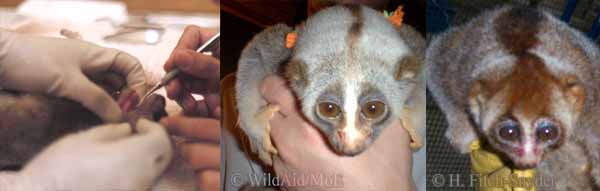 |
| Left: treatment of a confiscated slow loris in Jakarta whose teeth have been ripped out. Photo: H. Schulze. Middle, right: slow lorises showing superficial traces of abscesses on the muzzle. Such lesions can be the result of infections spreading along the tooth root channels after removal of the teeth. Photos: WildAid / MoE Cambodia, H. Fitch-Snyder. |
Treatment of confiscated animals whose teeth had been
ripped out:
Broken tooth remnants must be removed from the alveoli under
anesthesia.
In lorises, fine instruments and some practical experience
will be necessary
for properly doing this (one of us: U.
Streicher).
If no veterinarian with specific oral surgery and/or clinical
dental knowledge
is available, treatment by unskilled caretakers should be
restricted to
cautious cleaning of the oral cavity from broken or hanging
dental parts
which can easily be removed with the fingers, and the animals´
ability
to heal the damage from within with the help of their own
immune system
should be supported by providing good housing, tasty food that
can easily
be eaten or lapped up without teeth during the healing
process, a lot of
rest in cages with natural cover, systemic antibiotics and
some mild analgesic
(David A. Fagan, The
Colyer Institute,
pers. comm.). (Soft food which, however, does not stick to the
gums or
gets into open wounds, supporting development of bacteria?
Maybe minced,
soft food with antibiotics added, consolidated with gelatin?)
Some more information for skilled veterinarians: as long as
visible
wounds in the oral cavity are not healed, the gums must be
rinsed with
antiseptic solution every day to remove food remnants and
prevent or treat
infections. Beta blockers, given about 15 minutes before this
procedure,
may help to reduce stress. Suppurating abscesses along tooth
alveoli (see
photos) may be present. In such cases, dead tissue and pus
must be removed.
For treatment of tooth root abscesses in rabbits, Avery
Bennett (1999)
recommends to start antibiotic treatment prior to any surgery
and do skull
radiographs under anesthesia to assess the extent of affected
tissue. A
bacterial culture from the wall of the abscess may help to
determine the
resistance against antibiotics (bacteria within the pus in the
middle of
the abscess are often dead). If there is no possibility to
determine effect
of antibiotics in culture, antibiotic treatment should be
correlated to
the clinical signs; when treatment turns out to be
inefficient, another
antibiotic treatment with a different spectrum of efficiency
must be given
(R. Plesker, pers. comm.; Avery Bennett 1999).
One technique for treating an abscess is to leave it open and
allow
pus to leak out, rinsing the cavity with antiseptic solution
such as dilute
chlorhexidine or dilute povidone iodine 2-3 times daily until
healthy granulation
tissue is present. According to Avery Bennett´s rabbit study,
in
abscesses of the head it is important not to drain the abscess
into the
oral cavity, if possible; this would result in poor and
delayed wound healing.
Treatment may be supported by use of enzymes after rinsing to
help clean
the wound of dead tissues, fibrinous slough and pus, such as
papain/urea
(which digests dead protein matter and liquefies pus, but is
harmless to
viable tissue; for instance Accuzyme) or trypsin (which
digests collagen
fibre remnants; for instance Santyl, Leukase, Ixurol). Leukase
in cone
shape for implantation by Merck, Wien, for instance combines
antibiotic,
analgetic and enzymatic effects. Papain or trypsin should be
used according
to operating instructions, and not in combination with
commercially available
non-enzyme wound cleaners. Treatment with an antibiotic cream
or ointment
should be continued until the inflammation is gone and the
wound is well
epithelialized (for at least 10 days, but usually longer;
tooth root abscesses
tend to reappear). This kind of treatment, however, means
frequent handling
and considerable distress for a wild animal.
Another technique used to treat rabbit abscesses involves
surgical
removal of the abscess, tooth remnants and infected tissue
under full anesthesia
and subsequent implantation of antibiotic impregnated
polymethyl methacrylate
beads (AIPMMA) into the clean abscess cavity, where they will
locally release
antibiotic for up to five years. Polymethyl methacrylate
(PMMA) is a synthetic
polymer substance most often used as bone cement, the beads
need not be
removed, they heal into the jaw bone. A big advantage of this
method is
that wound can be closed and no further treatment is
necessary, which means
a minimum of distress, it also helps minimize use of oral
anibiotics
(Avery
Bennett
1999; Jenkins).
Further
reading about antibiotic granules: see Tobias et al.1996 (see
below:
references).
Lorises lacking full dentition might, even after successful
treatment,
have lasting problems with food consumption. Inability of the
animals to
chew properly or to defend themselves must be considered both
in diet and
group composition in rescue facilities; housing lorises with
and without
teeth together might cause problems. But observations in this
regard are
still lacking. Inability to gauge
holes into tree bark to lick up the sap, which in the
wild is an important
part of the diet (Wiens 2002), is certainly impossible without
teeth. The
ability of such animals to survive in the wild after release
should be
examined, maybe release on islands or in large semi-free
enclosures and
supplementation with adequate food remains the only option for
their longterm
survival.
Non-invasive urine dipstick tests for instance for kidney disease caused by wrong captive nutrition or liver disease caused by stress.
Fecal analyses including parasitological and microbial examination
D2) Prophylactic treatment against verminous parasites (nematodes, cestodes), , other parasites, see disease tables.
experience with anesthesia in N. pygmaeus at the Endangered Primate Rescue Center (by U. Streicher)
.
.
.
.
2) Veterinary certificate concerning a final examination of an animal housed / rehabilitated and supposed to leave the institution
,
Avery-Bennett, R., 1999: Management of abscesses of the head in rabbits. Proceedings of the North American Veterinary Conference, 1999, pp 822-823, Orlando, FL., online at http://www.mth.kcl.ac.uk/%7Ellandau/Homepage/Rabbit/abscess.html. College of Veterinary Medicine, University of Florida, Gainesville, FL. Seen 24 February 2004.
Tobias, K. M.; Schneider, R. K.;
Besser, T.
E., 1996: Use of antimicrobial-impregnated
polymethyl methacrylate
. J. Am. Vet. Med. Assoc. 208 (6): 841-5.
Jakarta Post, 2002: Tricks of the protected animal trade. http://www.orangutansonline.com/articles/article108.htm. 27 August 2002. Seen 30 March 2003
Jenkins, J. R.: New Bead Treatment for Jaw Abscesses. http://www.rabbit.org/chapters/san-diego/health/vet-talk/beadtherapy.html. Undated information in the house rabbit society website, http://www.rabbit.org/, Vet Talk pages by Dr. Jeffrey Jenkins. Seen 24 February 2004.
Kingdon, J., 1997: The Kingdon Field Guide to
African Mammals.
Academic Press, London.
Plesker, R., primate pathologist, Paul-Ehrlich Institut, Germany, pers. comm.
.
.
.
Streicher, U., thesis in preparation.
.
.
Wiens, F., 2002: Behaviour and ecology of wild slow lorises (Nycticebus coucang): social organisation, infant care system, and diet. Dissertation, Faculty of Biology, Chemistry and Geosciences, Bayreuth University.